Louis Schanker, Educator
The current revival [in woodcuts,] actually had its beginnings
before World War II. One of the pioneers was Louis Schanker,
a 51 year old New Yorker, who began fashioning woodcuts in 1935...
One of the earliest U.S. woodcut artists to do abstractions,
Schanker since has trained or influenced a generation of talented
younger artists.
"Comeback of an Art," Life Magazine, Jan, 1955
For three decades Schanker taught at the American Artists
School, The Brooklyn Museum, The New School, and
Bard College.
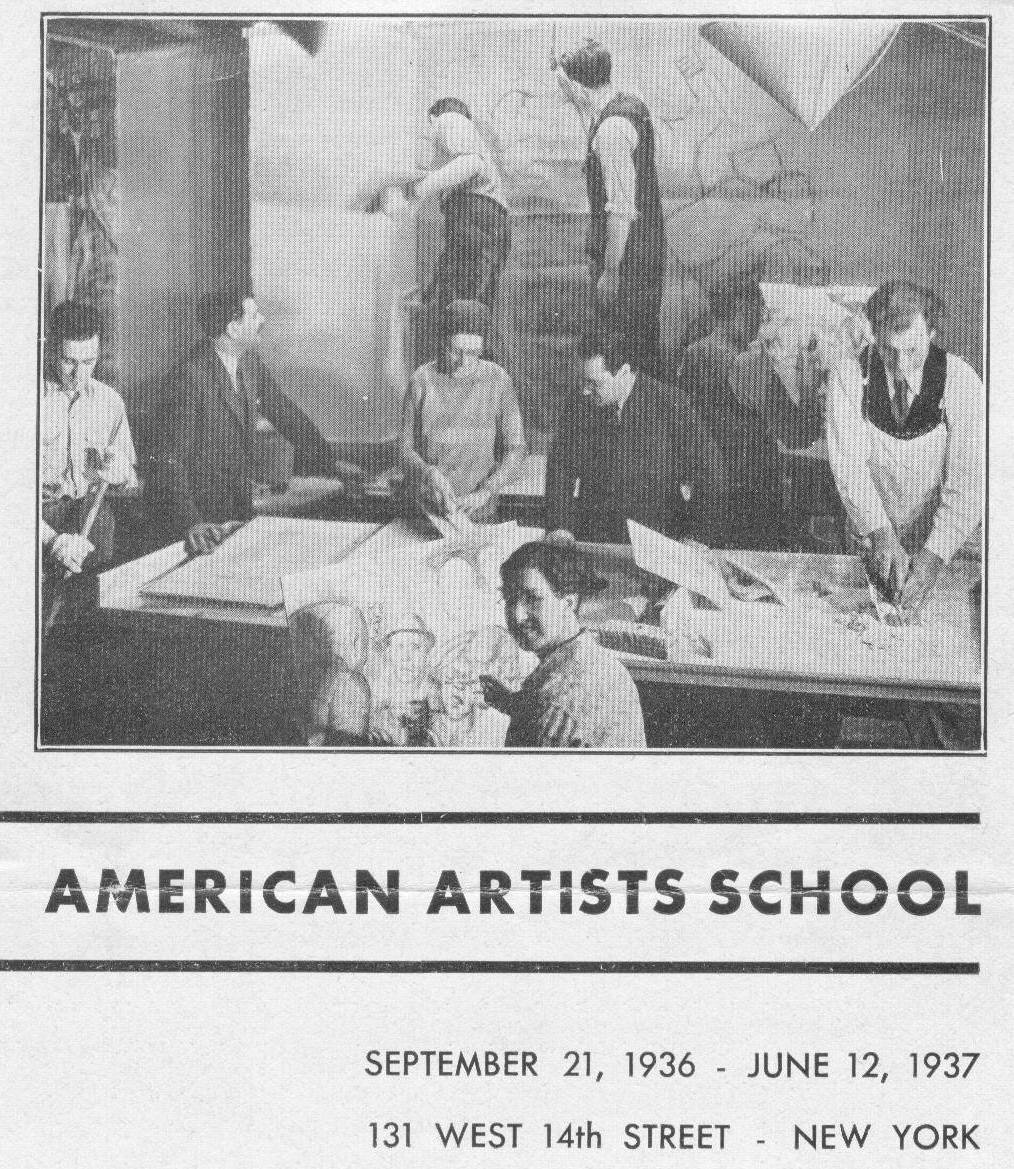
Schanker (2nd from left,) directing Mural Painting class
Selected Students:
William Littlefield Littlefield enrolled in evening classes for the Spring Term of 1953 at the
New School for Social Research in New York. On Thursday evenings Littlefield studied
“Woodblocks in Color” with Louis Schanker, one of the Whitney Dissenters and author of
Line-Form-Color. Schanker’s influence is clearly seen in Littlefield’s untitled color print dated
3/23/53 and was probably the inspiration for his color forms as seen in the production of numerous
mixed media paintings of oil and sand, and the collages created in the 1950's. By the mid-Fifties,
Littlefield had reinvented himself as an Abstract Expressionist and showed his recent works at both
the Regina and Brodley galleries in 1955. He was also included in the prestigious “New York Painting
and Sculpture Fourth Annual”at the Stable Gallery.
Vincent Longo
Bob Solotaire
Edythe Shedden
Carol Summers Summers attended Bard College in New York with the idea of specializing in painting,
but a year or two after he started his studies, Louis Schanker, one of the country’s most accomplished
woodcut printmakers, joined the school’s art faculty. “That was it for me,” Summers recalled. “He was
the cause of my falling in love with the woodcut medium.
One of his art majors says of him:
"Mr. Schanker's great contribution
to Bard is his lack of pretense.
He has a workman's approach to
art--it's honest and direct. And there
is a warmth and sincerity that gets
through to us. We respect him as an
artist and as a person."
Bard, Alumni Magazine, 1963
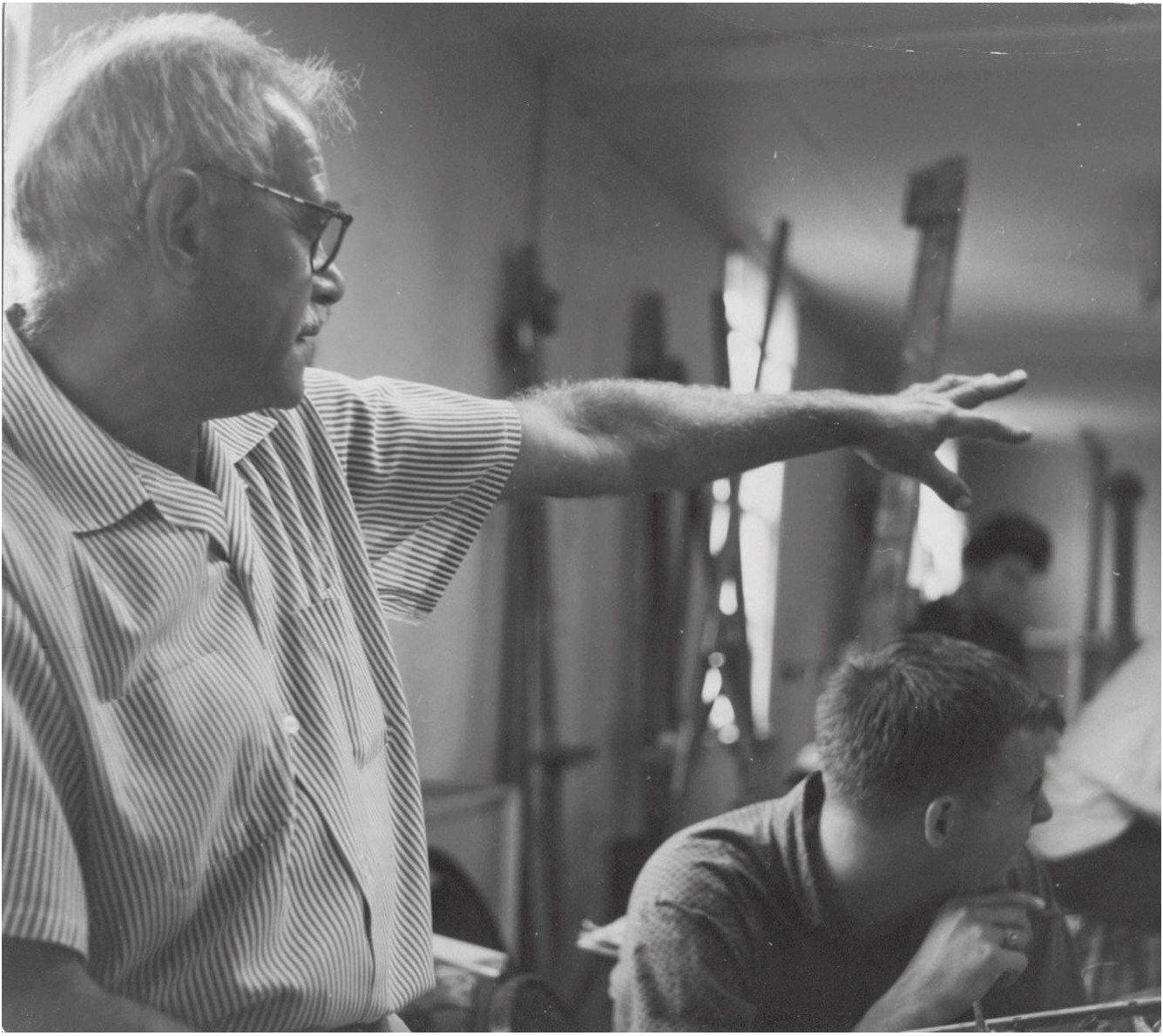
Schanker's class at Bard
Daniel Pinkwater, author, illustrator and NPR radio commentator was a
student of Schanker's at Bard College in the 1960's
The Pinkwater Copyright Infringement Jamberoo!
David Nyvall, the sculptor to whom I was apprenticed for three years, as a soldier had visited
Picasso at the close of the war. He told me that Picasso was cordial, invited him to stay to
lunch, and flattered him by treating him as a fellow artist and an equal.
But Nyvall wasn’t much like Picasso in his work, manner, or outlook. The closest I ever came to
meeting someone more or less of the Picasso type in person was my relationship with Louis Schanker,
who taught printmaking at St. Leon’s College [Bard College ] when I was a student there. Louis
was big, tanned, expansive, and rich. He drove to work sometimes in a Rolls Royce. He always
wore one of those blue chambray work shirts, and smoked cheap black Italian Parodi cigars.
Unlike the little pipsqueak art teachers with Master’s degrees who proliferate today, Louis was not
given to persiflage. You could sit with Louis for an hour, looking at samples of your own work- and
Louis might only speak once or twice- but what he said would be right on the money.
And his manner of expression was direct, simply, monosyllabic. He didn’t go in for jargon or
conceptual flights of fancy. Often he’d pass his hands over the picture, pointing things out:
“See, kid... this part here... this is nice... but don’tcha think it would work better if it came down here...
like so?” OR, “What if there was a little more yellow in this red here?” Things Louis might say.
Actually he never said them to me. He only ever said one thing to me- once or twice a week:
“Do more work, kid,” and rarely, “That’s nice. DO more.” It was all I needed.
So, the year after I graduated, when I read in the paper that Louis was having a show- of sculpture
yet- I’d never seen any of his sculpture- I was up to the gallery like a shot.
And who should be there, giving an interview to a reporter for an art magazine, but Louis himself!
“See lady... I was sitting in the house in Connecticut, watching the logs in the fire... and as the fire
consumed the logs, I began thinking that- while the fire was consuming the wood- deconstructing it,
if you will- I was witnessing an inverse of the process by which the wood had grown. This suggested
certain essential forms, which I could bring forth by carving partially burned logs. And always, I strive
toward the quintessential form, the seed, or nut. At the heart of most of the sculptures is the
suggestion of the germinal element. I discussed this with my friend, Robert Motherwell, and he said...”
Louis noticed me listening open-mouthed. I was experiencing the same sort of shock I’d feel when
my father would mysteriously break out of Polish/Pigin and speak grammatical English for a
sentence or two.
Louis leaned toward me and whispered, “You should always make up some bullshit to tell them.”